The house as a fortress
The War of the RosesThe house as a fortress is a changing idea in the Roses’ family life: the home is first a shared creation meant to shelter a family, then a contested asset and instrument of separation, and finally a perilous enclosure that cannot protect its inhabitants. Its meaning shifts with the marriage. The same house that gathers memories and labor around the family becomes the setting for a struggle over who may keep the life it represents.
A shared creation and family refuge
The house grows out of the Roses’ joint tastes and work. Its high ground-floor windows, ornamental ironwork, slate roof, and dormers exceed their expectations; delighted by its appearance, they have a copperplate engraving made and send it at Christmas. The building is more than an attractive possession: it gives outward form to their shared identity. Their weekends spent searching Virginia and Maryland for antiques, and European vacations shaped around collecting, fill its rooms with objects tied to their life together.
The home also embodies practical collaboration. Barbara Rose, interested in cooking and increasingly drawn to a catering business as the children need less of her time, has the kitchen designed with commercial use in mind. Oliver Rose supports the project energetically, spending weekends on its construction and working with contractors through his knowledge of circuitry and craftsmanship. Barbara Rose learns how household systems work, becomes able to repair faucets and appliances, and receives a tool chest from Oliver Rose. She has also helped him build the basement sauna and shower without a contractor. Their joint work on the house and its furnishings makes the later dispute about ownership a dispute over accumulated effort and a once-shared domestic world.
Divorce turns shelter into contested property
When the marriage breaks apart, the house becomes the largest shared asset and the clearest material expression of what the couple is losing. Oliver Rose tells Murray Goldstein that the house may be worth at least half a million dollars, with the antiques worth another half-million or more, and recalls how much love they put into the place. He initially says that half the value of the house and possessions would be acceptable because they built their life together. For him, that offer still carries the emotional logic of shared ownership.
Harry Thurmont makes the financial implications of the offer plain to Barbara Rose: Oliver Rose has offered half the value, not the house itself or its contents. An independent appraisal would establish market value, and a cash settlement could leave her with several hundred thousand dollars after fees. Barbara Rose rejects the idea that a monetary division settles what is fair. She points to nearly twenty years spent supporting Oliver Rose’s career and needs, giving up her schooling, raising their children, and devoting substantial labor to the house. She cannot match his earning power and sees the house as the principal lasting result of her contribution. Keeping it, for her, means keeping a way of life, not merely acquiring real estate.
Her catering venture sharpens the difference between a valuable property and financial independence. The separation agreement bars her from using household money for the business, yet slow-paying customers and suppliers who demand prompt payment leave her short of cash. She borrows from household funds and falls behind on utility bills. When a meat supplier cuts her off, mocks her accounts, and tells her that women should not be in business, she responds by throwing chopped meat at him; he drives his cleaver into the counter. Her struggle to make the business work shows how ownership of the house and access to money carry different kinds of security. The home is both the prize she wants to retain and the asset at the center of a legal and economic struggle.
A household that cannot contain the conflict
The house continues to hold the family physically together after the marriage has ceased to do so. Eve Rose tells Ann that Barbara Rose described the separation as a declaration of independence and wanted freedom to pursue her own aspirations rather than remain an appendage. Eve Rose had believed that her parents shared an exceptionally close life, in part because they did so much together around the house. The announcement unsettles her image of the family and leaves her unable to understand what her mother wants to escape.
The children’s responses reveal the cost of keeping everyone under one roof. At first, they try to bring their parents together, but their efforts fade as hostility becomes unmistakable. Eve Rose later refuses to go to camp because she fears leaving her parents alone in the charged atmosphere. She confides to Ann that she is afraid of what might happen and wishes either that her parents would reconcile or that one side of the family would move. The house remains a common address, but no longer functions as a shared emotional home. Ann, meanwhile, watches the household closely while concealing her own feelings for Oliver Rose, adding another strained relationship to an already unstable domestic system.
Fortress, trap, and collapse
Oliver Rose’s private memories give the fortress image its most explicit form. He remembers Eve Rose as a baby and the parents holding her between them, then remembers Josh Rose’s arrival and the family as a unit set against the world. In his recollection, he built the house to protect them. But that intention is contradicted by what the house has become: the spouses remain bound to the same contested space while resentment grows, and the children cannot leave without fearing what their parents might do there.
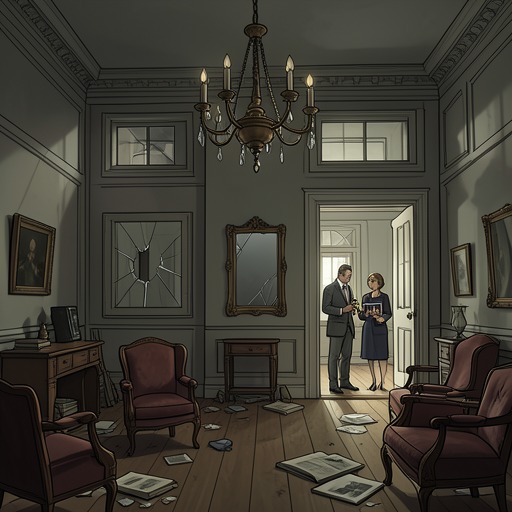
The home’s transformation into a dangerous enclosure is also literal. When Oliver Rose discovers surveillance equipment, he follows a wire through Eve Rose’s room and the corridor to the garden-facing window, confronts the man connected to it with a knife, and then dismantles the television equipment and camera. The intrusion makes the house a site of exposure as well as refuge: even its rooms and boundaries cannot guarantee privacy. In the final crisis, falling objects and structural damage turn the interior into an immediate physical threat. A banister gives way near the chandelier well, and Barbara Rose loses her balance, hanging two stories above the floor. Oliver Rose attempts to reach her across the Chandelier as the children escape.
What remains of the refuge
After the house collapses, Ann and the children enter to find a ruined interior: the roof has fallen, the walls have buckled, the long clock lies broken, and shards from the Chandelier cover the debris. Oliver Rose and Barbara Rose are dead beneath the rubble, their bodies appearing to embrace, their eyes fixed on one another. The image does not undo the years of conflict, but it places the couple together in death inside the wreckage of the home they fought over. The fortress has failed in its most basic purpose: it neither preserves the family as a living unit nor protects the people within it.
The house’s significance therefore rests on a bitter reversal. Its construction joined affection, labor, taste, and hopes for family life; the divorce made it a measure of contribution and a prize neither spouse could treat as merely financial. As the conflict overtakes the household, the structure that Oliver Rose had imagined as shelter becomes the setting of danger and destruction. The collapse makes physical what the family’s life had already disclosed: a home can preserve the marks of shared history without keeping its inhabitants safe or keeping the family whole.